

OEM Eyeshadow Manufacturer for Custom Product Development
Develop eyeshadow products from a brand specification, reference sample or R&D brief. Craft Eyeshadow supports formula direction, color development, texture, pan engineering, packaging, sample approval and bulk manufacturing for beauty brands serving global markets.
- 6 R&D engineers
- 1,316㎡ eyeshadow factory
- Custom samples generally 15–20 days
- ISO 22716 and ISO 9001
OEM, ODM and Private Label Serve Different Product Needs
The correct manufacturing model depends on how much product specification the brand already controls and how much development support is required before production.
| Model | Customer Provides | Factory Role | Best For |
|---|---|---|---|
| OEM | Product specification, reference sample, performance target or approved formula direction | Feasibility review, sampling, manufacturing, packaging coordination and quality control | Brands that already have a defined product requirement |
| ODM | Market position, target customer, product concept and commercial requirements | R&D support for formula, shade structure, texture, format, packaging and production | Brands that need product-development support |
| Private Label | Branding, desired product category and quantity | Supply available products and stock packaging with brand application | Faster launches and lower initial quantities |
Beauty Brands With a Product Brief
Suitable when the brand knows the target color, texture, pan format, packaging, performance and target market.
Benchmark-Based Development
Suitable when a physical reference is provided for color direction, texture, application or packaging evaluation.
ODM Development Support
Suitable when the brand has a customer and price position but needs help translating the concept into a manufacturable product.
Build a Clear OEM Eyeshadow Product Brief
The quality of the first sample depends on the clarity of the product brief. A useful brief connects market position with measurable product, packaging and commercial requirements.
Feasibility Review Before Sampling
The factory reviews whether the requested formula, finish, pan, packaging and quantity can work together. A product may need adjustment when the target performance conflicts with the selected texture, packaging or budget.
- Confirm whether an existing base formula can be adjusted
- Review raw-material and specialty-pigment availability
- Check whether the requested pan and palette structure are compatible
- Evaluate custom mold, printing and packaging MOQ
- Identify target-market documentation requirements
- Confirm a realistic sample and bulk-production schedule
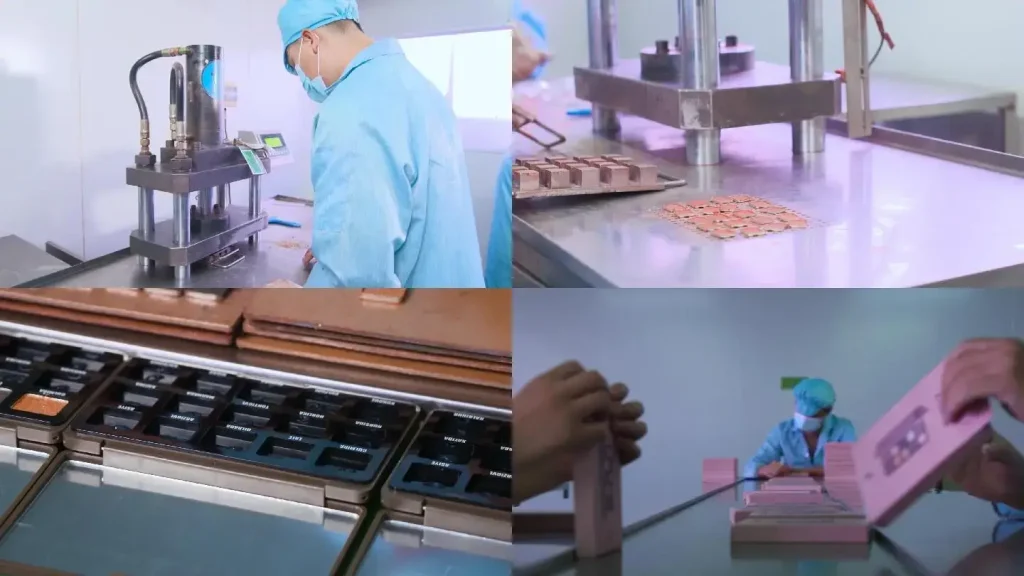
Formula, Color and Texture Development
Six R&D engineers support color development, formula adjustment, product testing and sample optimization. The development route depends on whether the project uses an existing formula, an adjusted base or a new product direction.
Formula Direction and Performance Targets
Our eyeshadow products are developed as vegan and cruelty-free. Talc and fragrance can be included or excluded according to the agreed brief, finish, raw materials and formula feasibility.
Pigmentation and Payoff
Adjust the balance between strong color release, buildability and the intended professional or consumer use.
Smoothness and Blendability
Review powder fineness, slip, adhesion and how the formula moves across the eyelid.
Long Wear and Water Resistance
Set realistic performance targets according to the formula category, finish and market position.
Color and Texture Development
| Finish | Development Focus | Important Approval Point |
|---|---|---|
| Matte | Undertone, pigmentation, powder fineness, blendability and hardness | Pan appearance, skin swatch and blending performance |
| Shimmer | Pearl size, shine, base color, smoothness and adhesion | Reflection under normal and direct light |
| Metallic | Silver-effect and pearlescent material balance, reflective intensity, sparkle appearance, pickup and pressed texture | Reflective intensity, sparkle balance and surface stability |
| Duochrome | Base color, main reflection and secondary shift | Multiple viewing angles and lighting conditions |
| Multichrome | Shift path, particle effect, base opacity and visual intensity | Physical sample and multi-angle comparison |
| Holographic | Rainbow reflection, sparkle size and base transparency | Laser effect under direct light |
Pans, Product Formats and Packaging Development
Pan and Product Format
Pan dimensions affect product weight, pressing behavior, palette layout, breakage risk, packaging space and cost. Common options include 26mm round, 23mm square and 26mm square pans in aluminum or tin/iron.
- Single pan, compact or multi-pan palette formats
- Standard and custom pan shapes or dimensions
- Aluminum or magnetic-compatible tin/iron pans
- Paperboard, plastic, acrylic and magnetic palette structures
- Standard formats or custom mold evaluation
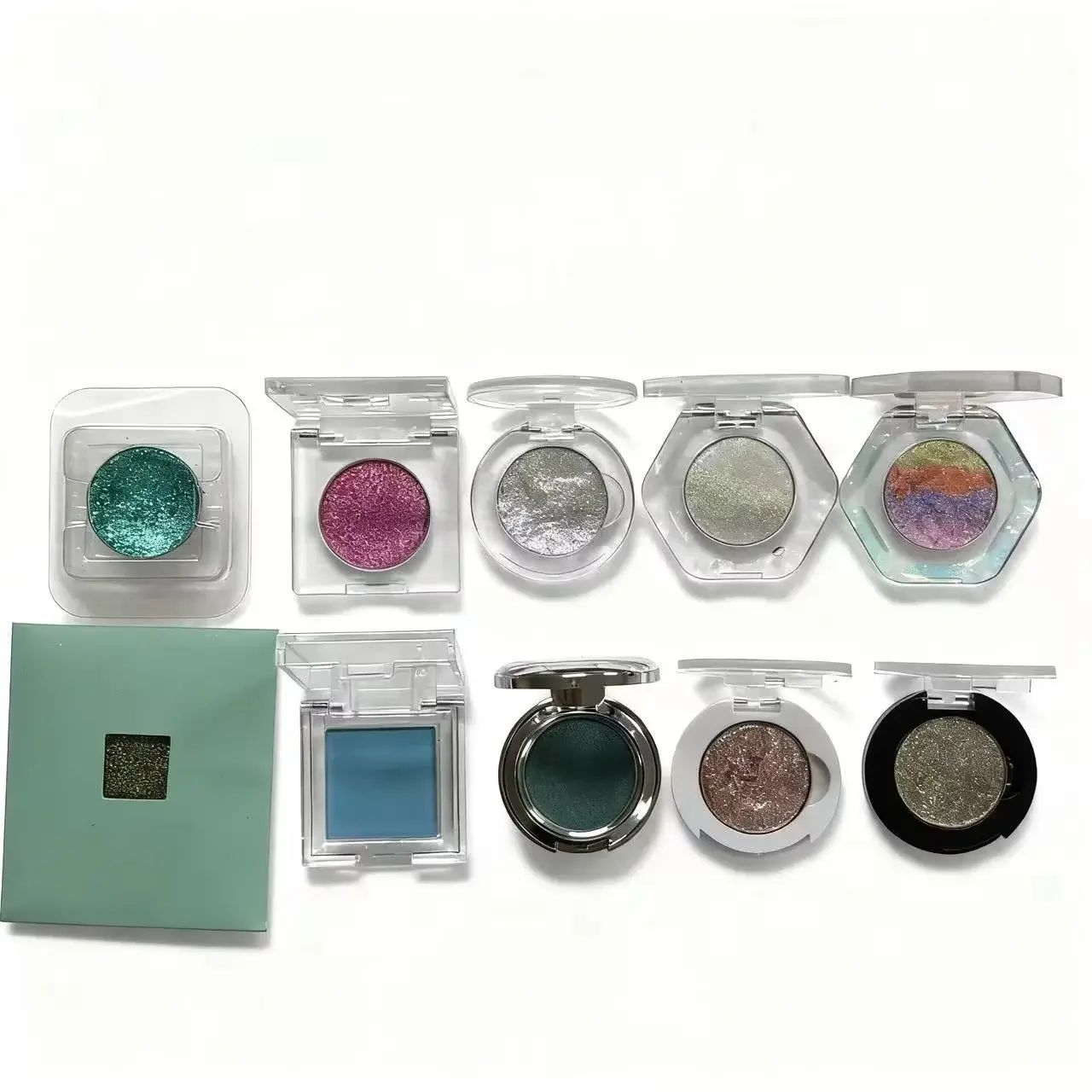
Packaging Engineering and Component Compatibility
OEM packaging work focuses on whether the selected pan, formula, palette structure and packaging components can be produced and assembled reliably. Visual branding remains part of the final artwork, but the technical review begins with component fit, product protection, sourcing and production feasibility.
Palette layout, pictures, shade names, logo placement and detailed visual artwork are covered on the Custom Eyeshadow Palette page.
Sampling, Approval and Bulk Manufacturing
Sample Development and Revision
Custom samples generally require 15–20 days. The sample stage confirms whether the agreed shade, formula, texture, pan, palette and packaging direction can meet the product brief.
- Compare color and undertone with the reference
- Review pigmentation, smoothness, adhesion and fallout
- Check pressed-powder surface and pan compatibility
- Review packaging structure, artwork and logo placement
- Record revisions before final approval
- Use the approved physical sample as the bulk-production reference
From Approved Sample to Bulk Production
After the final specification and physical sample are approved, the project moves into material preparation, powder production, color comparison, pressing, palette assembly, inspection and packing.
Quotation, Production Timing and Compliance Support
Information Required for an OEM Quote
- Expected sample and bulk quantity
- Product type and number of shades
- Texture and formula requirements
- Pan and packaging specifications
- Reference product or performance benchmark
- Target market and required documentation
- Target cost and planned delivery date
Bulk production generally takes 35–40 days after the product, packaging and physical sample are approved. Express delivery generally requires 7–15 days, while sea shipping is normally about one month.
Quality and Compliance Support
Craft Eyeshadow operates with ISO 22716 and ISO 9001 management systems. The factory supports production management, process control and quality checking for eyeshadow projects.
For brands entering overseas markets, documentation support related to EU CPNP and UK SCPN product notification can be discussed according to the formula, product and destination. CPNP and SCPN are product-notification systems, not factory certificates.
Review factory informationOEM Eyeshadow Manufacturer FAQ
What is the difference between OEM and ODM eyeshadow manufacturing?
Can you develop an eyeshadow formula from a reference sample?
Can the formula be vegan, talc-free or fragrance-free?
How long does OEM sample development take?
What MOQ applies to OEM eyeshadow?
Do you support only eyeshadow palettes?
Start an OEM or ODM Eyeshadow Project
Send your reference product, target texture, color direction, pan and packaging requirements, expected quantity, target market and planned delivery date. Our team will review feasibility before recommending a sampling route.